Every technology before this one helped your people decide. This one decides. That changes what "ready" has to mean.
About 35 questions, built for hospitals, specialty pharmacies, PBMs, and hub programs — not a generic quiz. We read your data, your people, and your rules, and hand you the one that would break a deployment first. Even if it means telling you to wait.
Free · about 20 minutes · built for your type of organization
A hospital's data problem isn't a pharmacy's. A PBM's automation pressure isn't a hub program's. You pick who you are, and every question that follows is written in your language.
Your EHR isn't a data strategy. We ask what your clinical data can actually support, whose decisions your AI would take over, and who could stop an algorithm that starts getting it wrong.
Nine systems and no shared patient record isn't an IT nuisance — it's the thing that decides whether AI works. We ask where your data really lives, who owns the workflow AI would absorb, and what happens the first time it's wrong.
Automation lands on prior authorization and claims first. We ask whether the data underneath those decisions holds up, whose judgment the automation replaces, and what keeps it in check at full volume.
Care coordination runs on people and workarounds. We ask which of your workflows are truly ready for AI, who'd carry that change, and who'd quietly resist it.
Same questions, same standard of evidence — asked in the language of your setting. If yours is marked in build, the guided assessment can still run today; the self-serve version follows.
Enthusiasm is not readiness. Most scores can't tell the difference.
Pilots launched. Licenses bought. Adoption tracked. That's what gets counted as "ready" — and it misses what makes AI different. Every technology before this one sat beside your people's judgment. AI takes the judgment over. It reads the scan, flags the claim, routes the patient — decisions someone used to own. An organization can clear every conventional readiness bar and still be unprepared for the first AI decision that goes wrong. Usually, it finds out at the worst possible time: after deployment.
Reports forgive messy data. AI doesn't. A model trained, tested, and monitored on fragmented or stale data fails quietly and confidently. We read what you actually have — not what the system diagrams say you have — and whether it can carry the weight you're about to put on it.
AI doesn't just change workflows. It takes over decisions people built careers on — and no training session fixes that. We map who's affected, who carries the change, who quietly resists it, and whether anyone has honestly reckoned with the authority those people are about to lose. Because that's what stalls deployments. Not the technology.
Who decides what the AI gets to decide? Rules written around today's software die with today's software. We check whether your rules stand on things that don't change — who's accountable, what gets logged, when a person must step in — so they outlive any system they were written for.
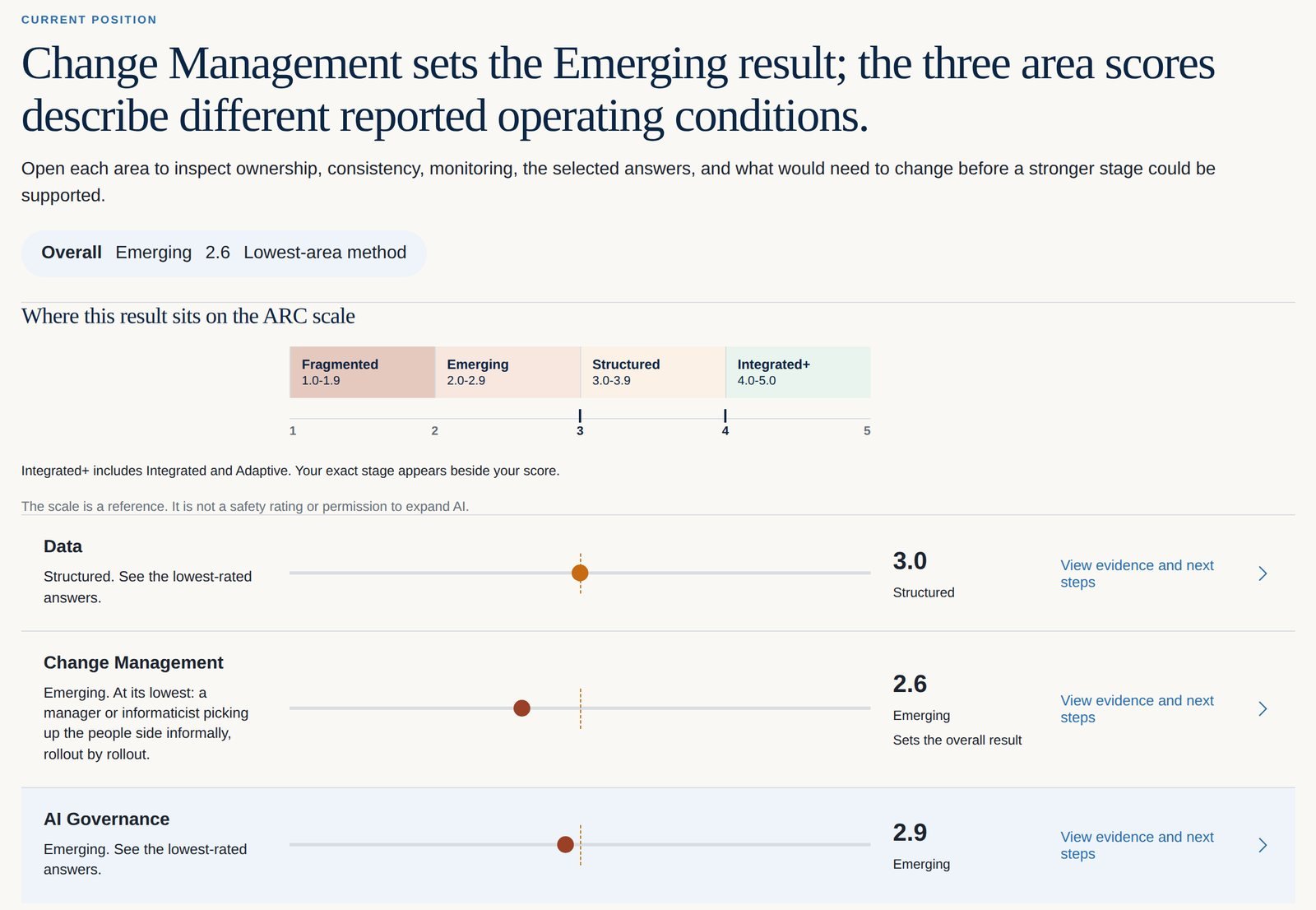
Most assessments average your strengths against your weaknesses and hand you a comfortable number. We don't. Strong data can't compensate for people who don't trust it. If you score a 4 on data and a 2 on people, you're a 2 — because the deployment that fails will fail through the 2.
Two more things most tools won't do. If too many questions go unanswered, we don't score you at all — we'd rather say "not enough to go on" than hand you a number we invented. And your free result is clearly marked "Self-reported — unverified," because that's exactly what a self-assessment is.
About 35 of them, in your organization's own language.
Your data, your people, your rules — each read on its own.
No averaging. The lowest area is the one that decides.
One of five — read from that weakest area, nowhere else.
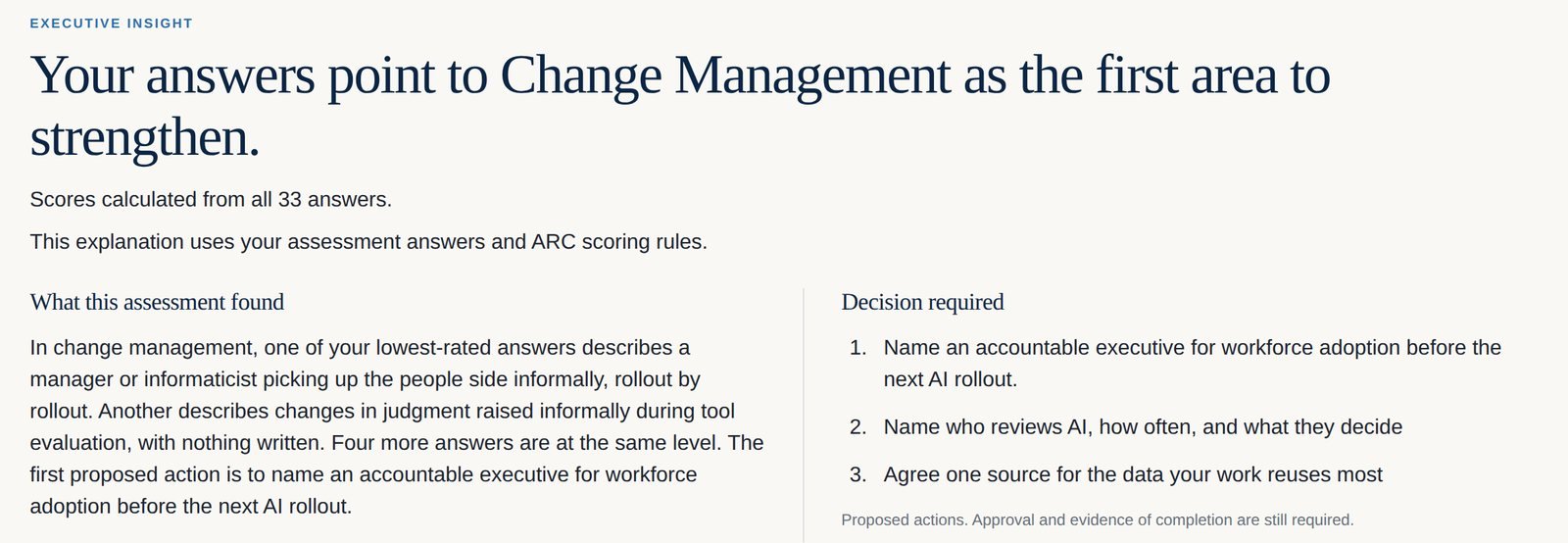
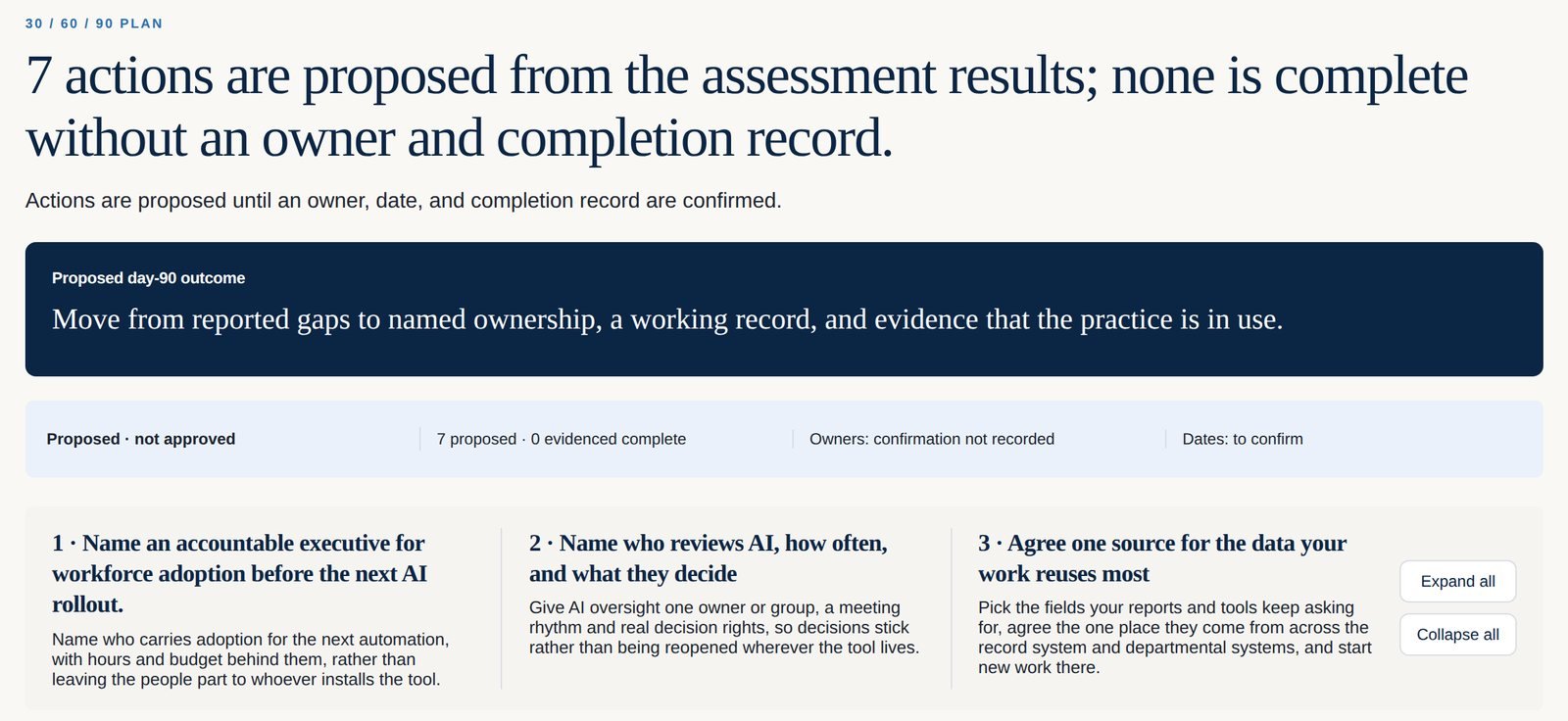
The stage, the weakest area, and the short list of decisions that would move it.
Built to absorb the next model, not just this one.
Data, people, and rules working as one system.
Real plans, real owners, early discipline.
Pockets of progress, nothing connected.
Every team solving AI on its own.
Readiness reads from the weakest pillar.
Score a 4 on data and a 2 on people,
and you're a 2.
The deployment that fails will fail through the 2.
You get your stage, your weakest area, and the short list of decisions that would move it — not a trophy number for a board slide.
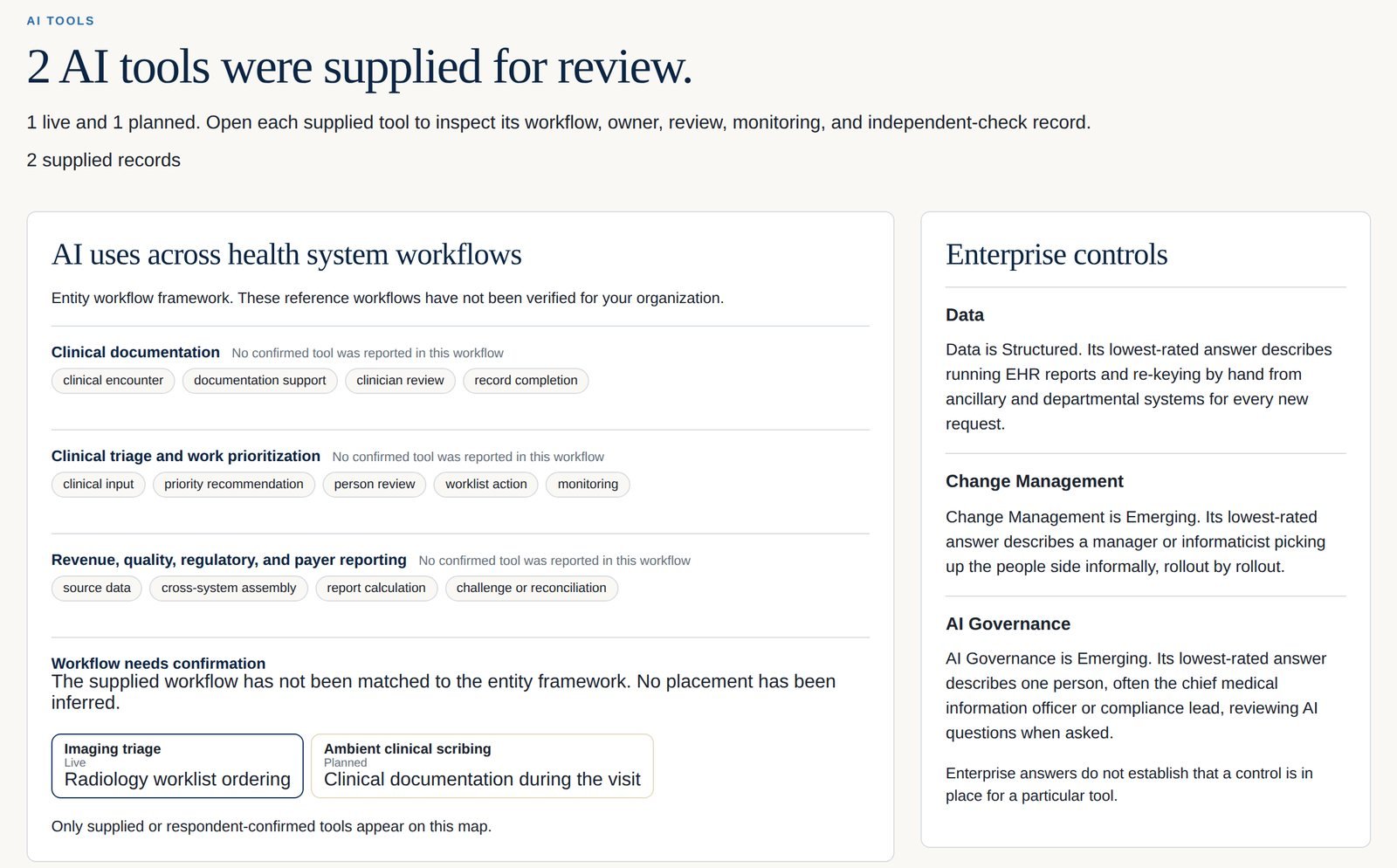
The guided version goes further, because your whole leadership team answers — each person covering what they actually own. It then checks those answers against each group your AI touches and shows where readiness is uneven. It's a reading, not a verdict on each group. It tells you where to look before something breaks there.
And when your CIO answers 4 and your quality director answers 2 on the same question, we don't split the difference. We flag it. That disagreement is one of the most useful things an assessment can find.
If AI that acts without a person clicking approve is anywhere on your roadmap, the guided assessment adds one look ahead: not whether you could build it — whether you could keep it safe at full volume. If that's not on your horizon yet, skip this and come back when it is.
The free check tells you where to look. The guided assessment tells you what to do.
ARC comes out of Artha Consulting Lab — built by Ankur Jain, Esq. after fifteen years inside biopharma, pharma, and health-system transformations, watching confident readiness scores fund deployments that failed. This is the same set of questions we use in paid engagements. The free check is the first rung of the real thing, not a quiz built to capture your email.
It's not a certification — nobody should certify readiness from a questionnaire, including us. It's not a vendor recommendation, a legal opinion, or an implementation plan. And a high score is not permission to deploy — it means fewer things standing in your way, and the report tells you exactly which things remain.
Whoever owns the AI question — strategy, operations, informatics, quality. It's built for one respondent. The guided version is where the rest of your leadership comes in.
It's enough to know where to look. About 35 questions, written for your type of organization, scored against your weakest area — built to find the constraint. What it can't do alone is cross-check one leader's view against the rest of your team. That's what the guided assessment adds.
They produce your report, and they stay yours — no public benchmark, no directory, no sharing. No patient data is involved anywhere: the questions are about your organization, not your patients. Guided engagements run under a confidentiality agreement before anything is discussed.
No — and be careful with any assessment that says yes. A high score means fewer obstacles. The report names the ones left.
It's arguably the most useful time. The assessment reads what's actually live — and mid-flight is when the weakest area starts to show.
If there's not enough to go on, we say so instead of inventing a score. Built for your kind of organization, marked for what it is. Find your weakest area before it finds you.
Readiness asks whether you can start. The AI Governance Diagnostic asks what you could show tomorrow — every governance claim graded on the evidence behind it, from what you told us to what you demonstrated live. A governance-readiness readout, not a compliance certification.
Thirty minutes, on your calendar, no forms in between.
Prefer email? ankur.jain@arthaconsultinglab.com